
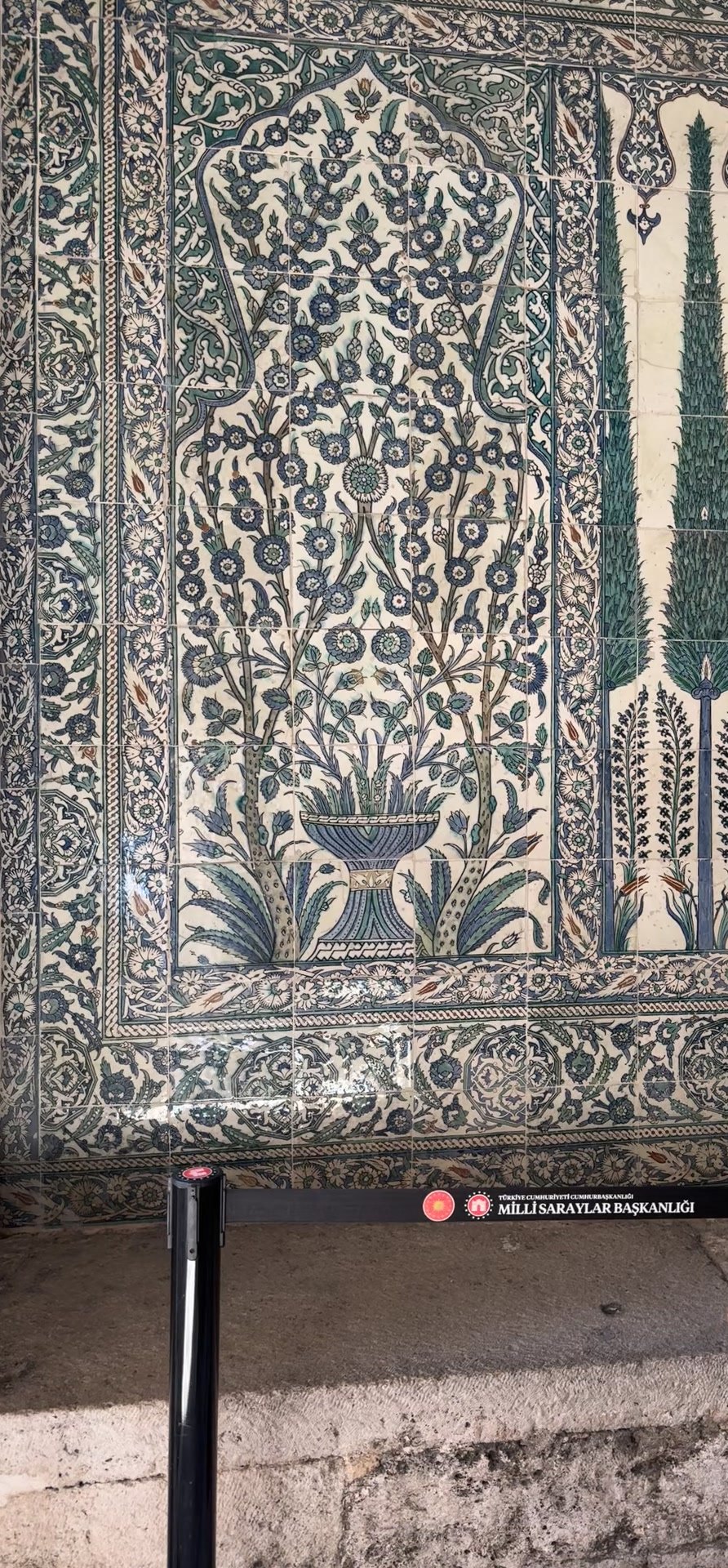
Tiles cover the walls of the Harem rooms we saw, and they were the first thing we photographed on 26 July 2026. This article covers four of them: a tree-of-life panel with cypress trees, a fireplace in blue and white, a wall of tile arches under a band of calligraphy, and a small exhibit of sample tiles. All photos are ours.
Our sources: The photographs are ours, from the same family visit on 26 July 2026, and the notes we wrote beside each one. Faces are cropped. We are visitors, not tile specialists.
Turquoise, blue and green
Our notes say that most of the wall decoration in the Harem apartments is Iznik tile. The colours we saw were blue, green and turquoise. Around the tree-of-life tiles we noted stylised flowers (hatayi), five-lobed motifs (penç) and long dagger-shaped leaves (hançer yaprak) on the surrounding wall tiles. Published studies usually date many of the Harem’s tile panels to the 17th century. One example is this Marmara University publication on 17th-century tile panel designs in the Harem (in Turkish).
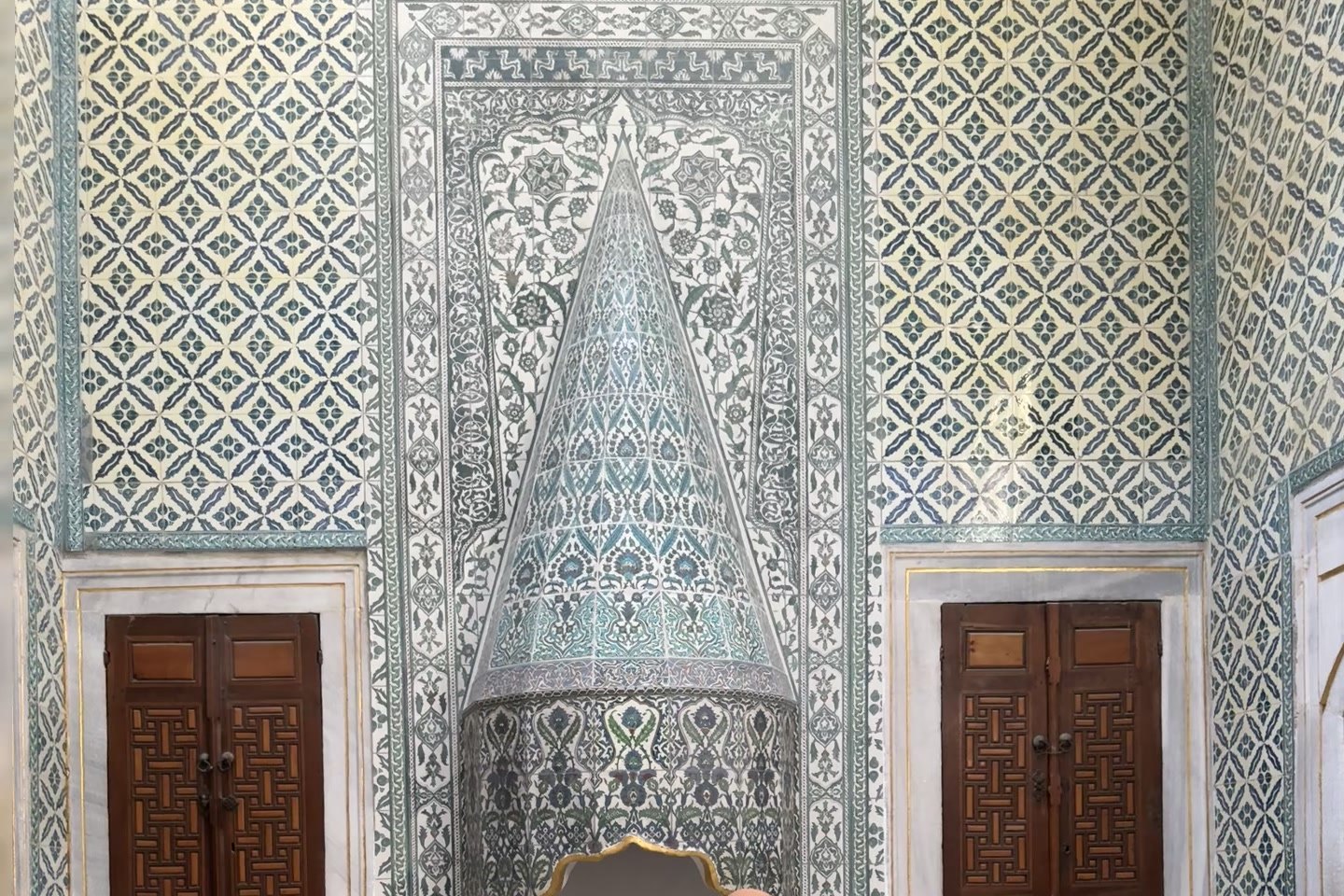
A fireplace in blue and white
The fireplace caught our attention, because it was not an ordinary one. Its hood and the wall around it are covered in blue-and-white tiles with çintemani, hatayi and hançer yaprak motifs. The çintemani design is usually described as groups of three balls, sometimes with wavy stripes. Carved wooden shutters stand on either side.
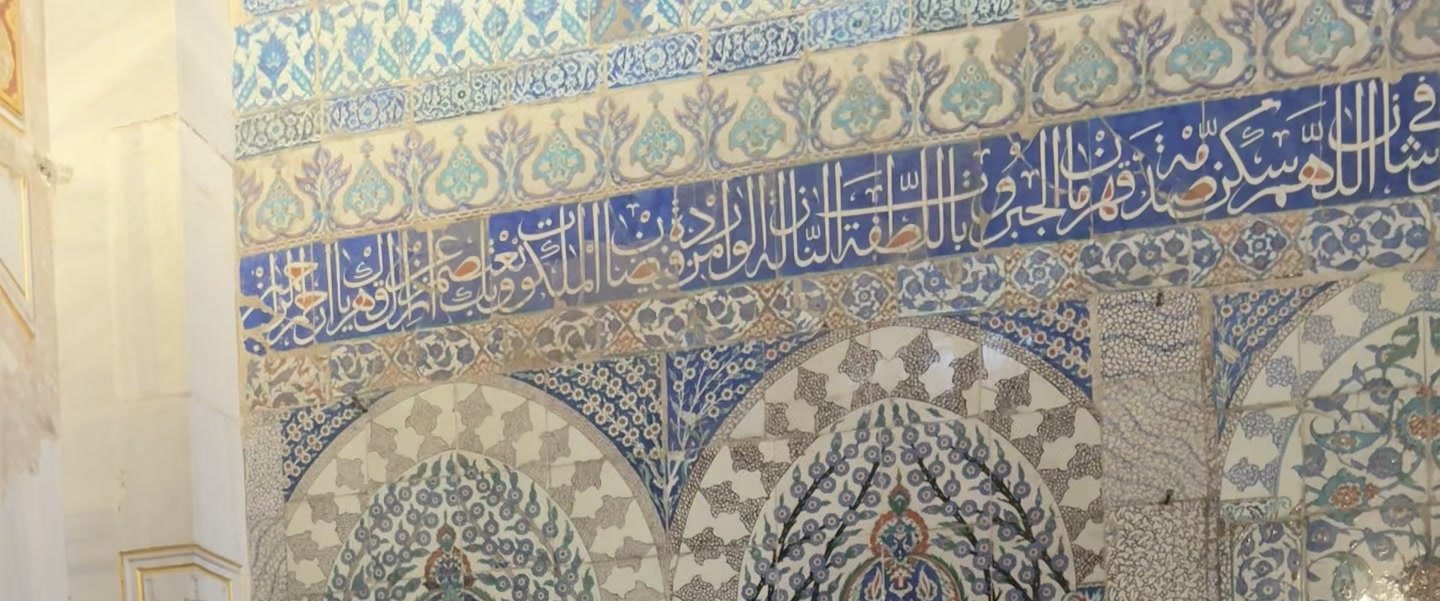
Tile arches and calligraphy
Another wall had a row of pointed tile arches, each filled with a symmetrical flower design, below a band of blue calligraphy. The design inside each arch is different.
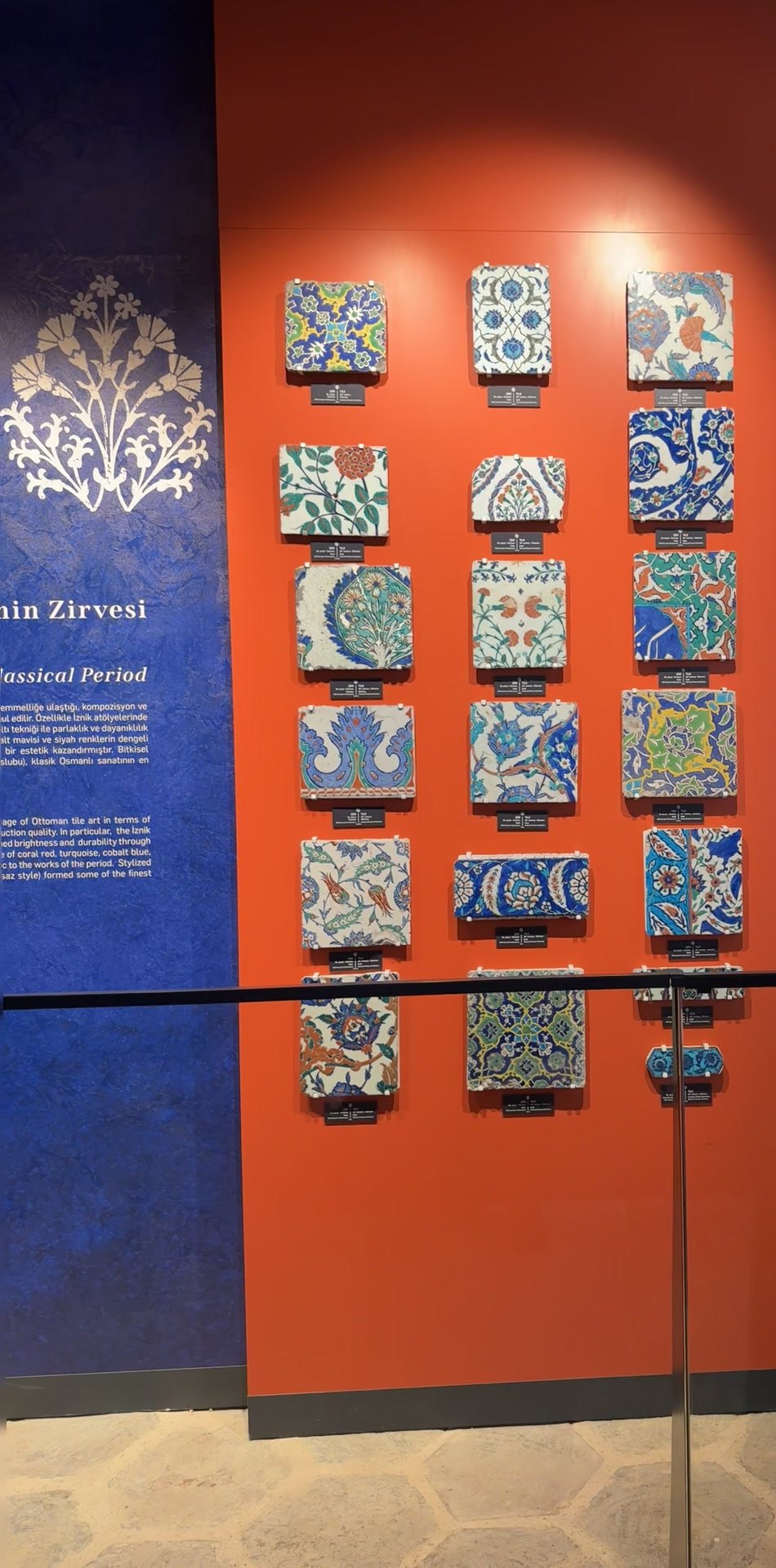
A wall of sample tiles
Near the end of our walk we reached a small exhibit that showed single tiles on an orange panel against a deep blue wall. The label read “Classical Period” in English. Seeing the tiles one by one made it easier to pick out the same flowers and leaves on the big panels.
Tile making today
Our notes add that tile making continues today, in teaching and in production, in Iznik, Kütahya and several other Turkish cities.
How to look at the panels
- Stand back first. The overall pattern is easier to read from two or three metres.
- Then pick one flower or leaf and look for it again on the next wall.
- The panels are behind barriers, so a phone zoom helps more than moving closer.
- We are not tile specialists. We recorded what we saw and what the signs said.
Where to go next
Read on: glass, inlay and gilding, the great hall, the full route through the rooms.
Frequently asked questions
Which tiles are in the Harem?
Our notes say most of the wall decoration is Iznik tile in blue, green and turquoise.
What does çintemani mean?
It is a decorative motif of three balls, often over wavy stripes. We saw it on the tiled fireplace.
