
On the last stretch of our Harem visit on 26 July 2026 we stopped at a wooden staircase that our notes call the Cevri Kalfa Staircase. It is a plain stair, but a story from 1808 is attached to it. This article tells what we saw, what the sources say and where they disagree.
Source note: The photo is ours, taken on 26 July 2026, and so are the visitor notes. The history comes from the published sources we link, which we read afterwards.
What we saw
The staircase stands in a courtyard of whitewashed arches, with a stone column in front of it. A glass partition and barrier ropes close off the passage. Our notes say it links the courtyard with the rooms of the Black Eunuchs (kara ağa). The Harem has more than one staircase, so check the museum label on the day to confirm that you are looking at the same one.
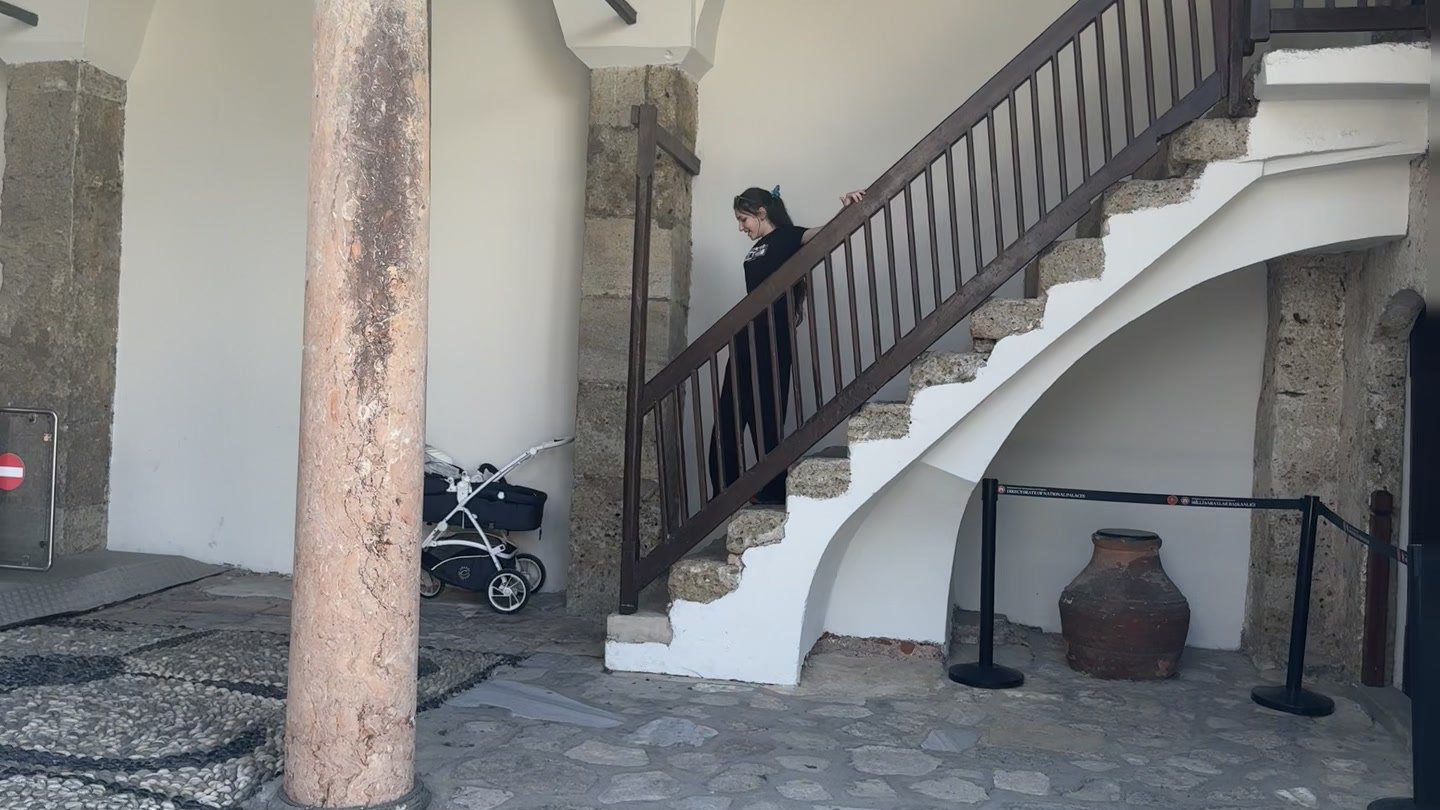
The story of 1808
Cevri Kalfa was a senior female servant (kalfa) of the Harem. The TDV Islamic Encyclopedia (in Turkish) links her to the palace coup of 1808. The staircase is on the corridor known as the Golden Way (Altınyol), and one account says she threw hot ashes at the executioners who were climbing the stairs. In that account, the young prince Mahmud, the future Sultan Mahmud II, could hide and survive.
Sources disagree on the details, including the date of her death, which one source gives as 1825 and another as 1826. We therefore tell the story as an account and do not present every detail as proven.
What happened to her afterwards
According to the same encyclopedia, Mahmud II rewarded her with the post of chief treasurer of the Harem, the second most important position in its hierarchy. She later built a school and a fountain, and was given land in Üsküdar, where the spring water became known as Cevri Kalfa Water. If you cross to the Asian side, our guides to the Mihrimah Sultan Mosque and the Üsküdar book bazaar are in the same district.
Why we stopped here
It is easy to walk past a staircase in a palace full of tile and gilding. We stopped because the history attached to it is concrete. One act on a narrow stair is said to have saved a prince who later became sultan.
Where to go next
Read on: the women who lived here, the full route through the rooms, glass, inlay and gilding.
Frequently asked questions
Who was Cevri Kalfa?
She was a senior servant of the Harem who is remembered for helping a prince survive in 1808, and who was later promoted to chief treasurer.
Can you climb the staircase?
We did not climb it. Our notes say a glass partition closes off the passage, and our photo shows barrier ropes.
