
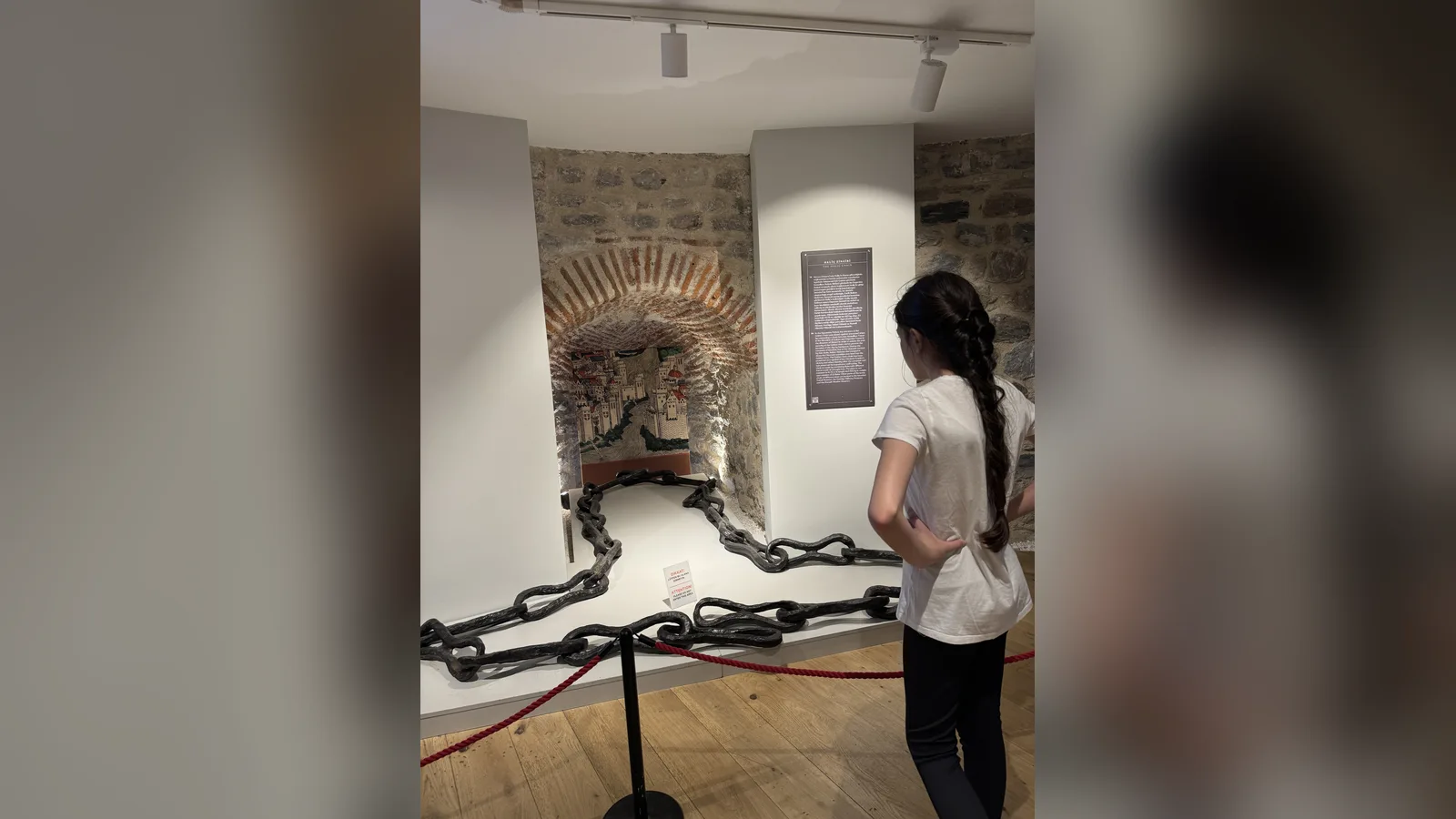
On the fourth floor of the Galata Tower Museum a length of heavy iron chain lies in a brick niche. We visited on 4 July 2024. Here is what we saw on the fourth and fifth floors, and the story the chain tells.
First-hand note: We visited the Galata Tower Museum as a family on 4 July 2024. Every photograph in this article is ours, taken on iPhones, and we blurred the faces of our family and of other visitors. Exhibits, prices and queues may have changed since then, so we checked the floor plan against the Ministry of Culture and Tourism museum portal in November 2026.
The Golden Horn chain
The Ministry of Culture and Tourism museum portal says the chain of the estuary is one of the important artifacts on the fourth floor, and that it has been preserved as a symbol of the Ottoman victory and of the city’s identity. During the siege of 1453, the defenders of Constantinople stretched a chain across the mouth of the Golden Horn to keep enemy ships out of the harbour. The Ottoman fleet under Sultan Mehmed II still reached the inlet, according to the Fall of Constantinople article, by being hauled overland. Our notes, written the same day, describe the chain as a part of the barrier meant to stop Ottoman ships from entering the Golden Horn.
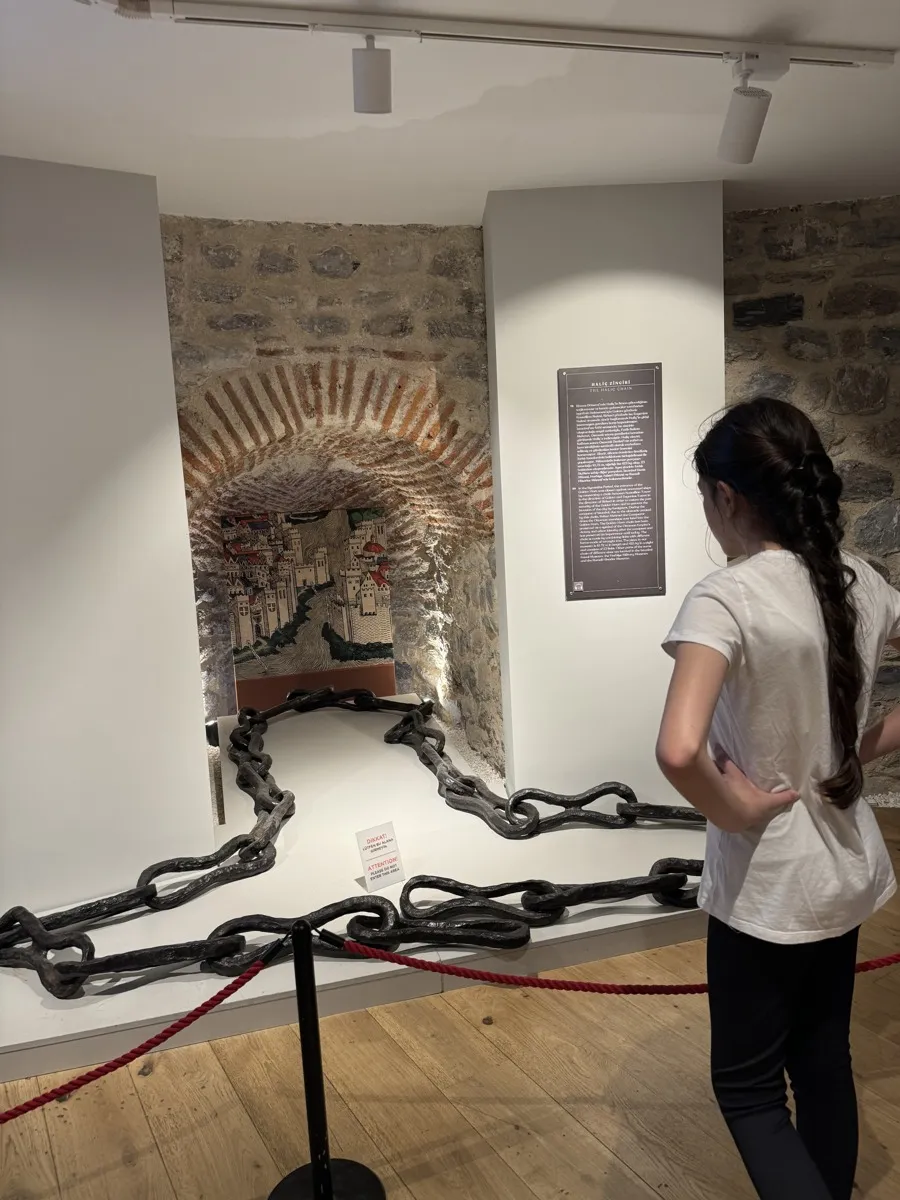
In our photograph the chain is laid out in loops on the floor of an arched niche, behind a rope and below a panel. We could not measure it, so we do not give a length or weight. The panel is where to look for the details.
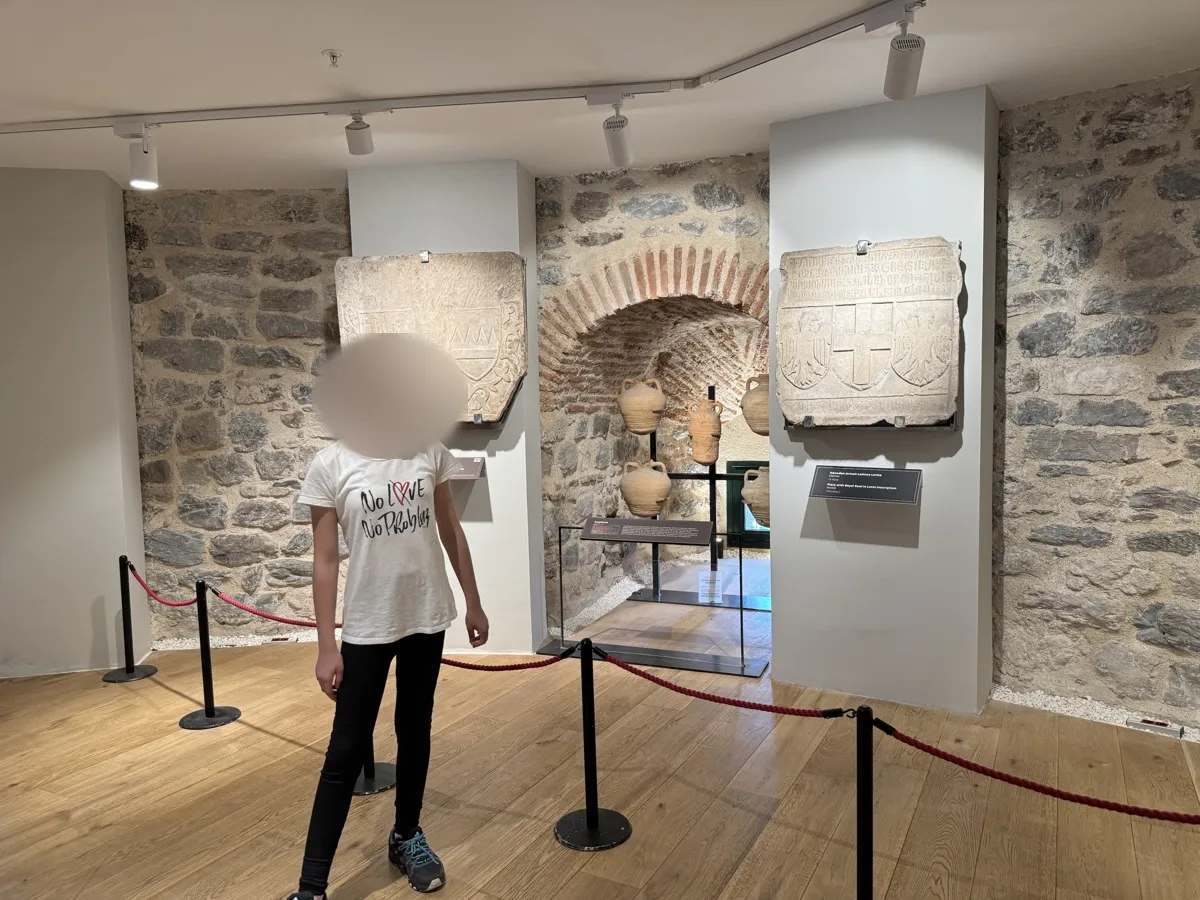
Stone slabs and amphorae on the same floor
Our timestamps put the next photo only 12 seconds before the chain, so the objects stand close together. It shows two carved stone slabs on a gallery wall with large clay jars beside them. One slab seems to carry a shield with a cross-like device. We did not record the labels, so we will not say what they depict. This is a good place to stop and photograph the captions, because the details are easy to forget.
The fifth-floor showcases
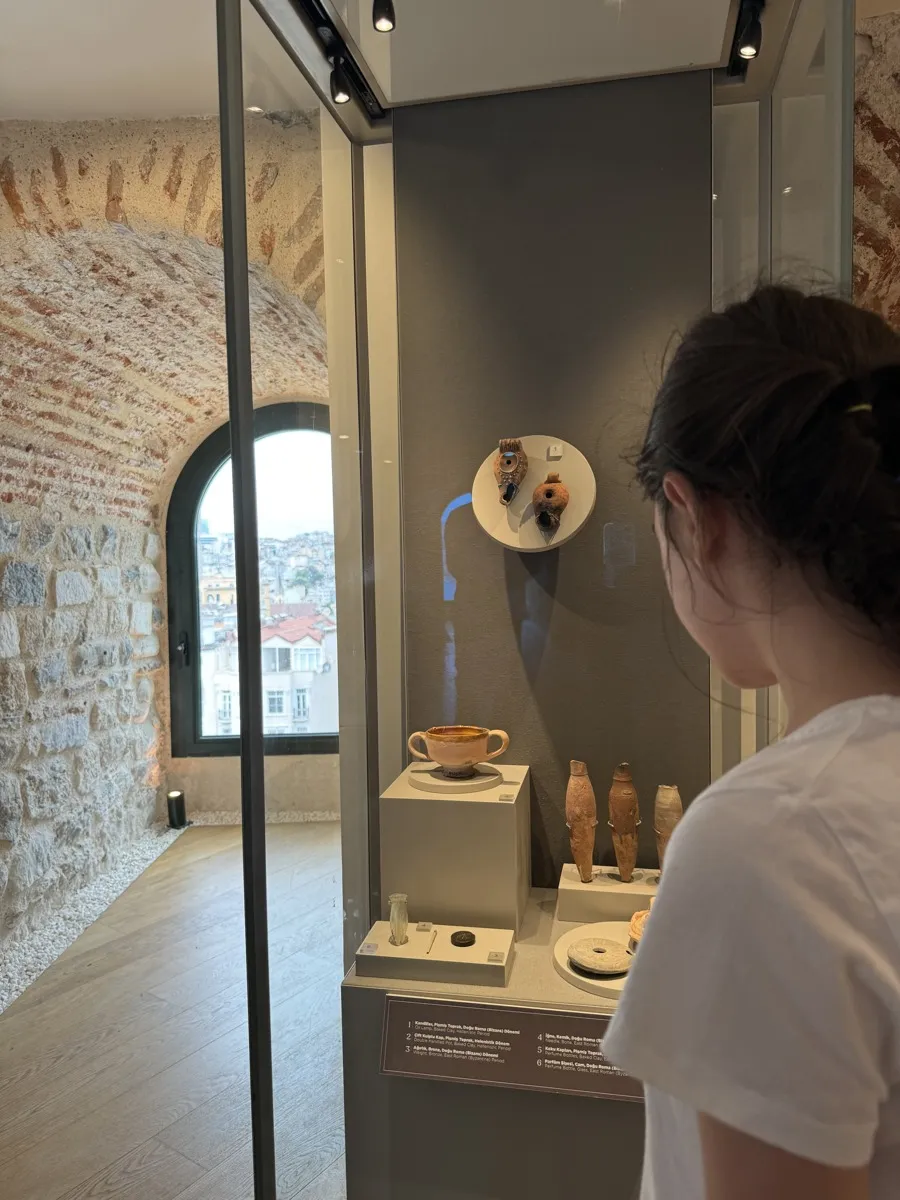
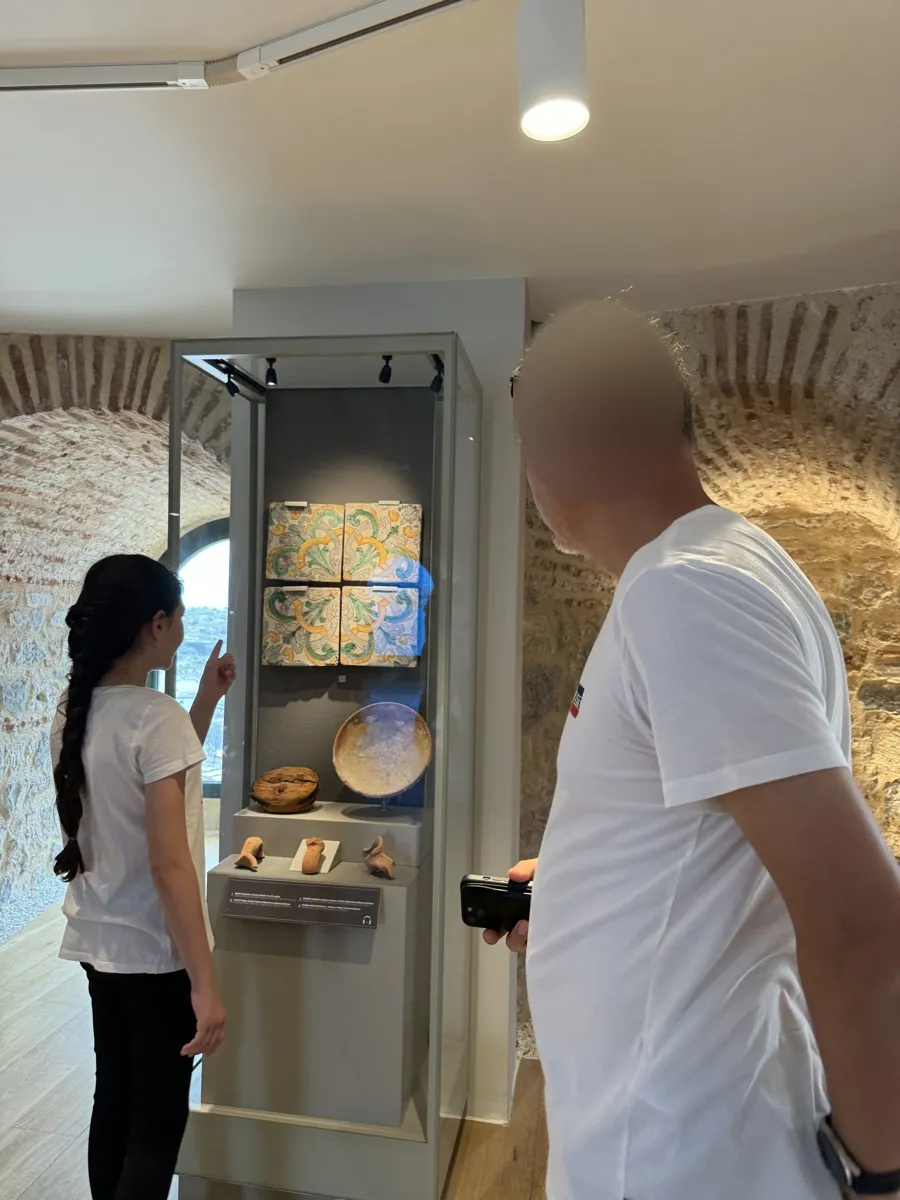
According to the portal, the fifth floor holds five showcases of artefacts from the Neolithic, Roman, Byzantine and Ottoman periods. In our photos, a tall glass case holds small cups, jugs and other pots, and a window behind it frames rooftops. Another case shows coloured tile fragments and a plate.
How to look at the exhibits
- Photograph each label. It lets you check the period and the name at home.
- Go slowly on the fourth floor. The stair passage starts here, and the chain, slabs and jars are all close together.
- Do not expect a large collection. The museum is small, and the views and the building matter as much as the objects.
Where to go next
Read on: our floor-by-floor visit, the city model, binoculars and views, visiting with a child.
Frequently asked questions
Where is the Golden Horn chain in Galata Tower?
On the fourth floor, according to the Ministry portal. We saw it just before the staircase that leads down through the tower wall.
Why does Galata Tower have a piece of the Golden Horn chain?
The chain belongs to the story of the 1453 siege, and the tower stands above the Golden Horn. The museum shows it as part of the city’s history.
